The old tripartite system, founded upon the 1944 Education Act and expanded in the post-war years, recognised a fundamental truth about human nature: not all children learn in the same way, nor are all called to the same vocation. Some are naturally gifted in the academic arts; others in technical or practical skill; others in trades that require discipline and cooperation rather than abstract reasoning. The Grammar schools refined intellectual promise; the Technical schools cultivated inventiveness; the Secondary Moderns trained skilled workers and artisans who were the backbone of Britain’s industries and communities.
This system, though imperfect, reflected a meritocratic ideal rooted in natural justice and Christian realism. The 11-plus exam, offered a fair and objective measure of aptitude and allowed children of working-class families to ascend through hard work and intelligence. Many of Britain’s finest minds, from miners’ sons to factory workers’ daughters, won their place in Grammar schools through grit and ability. Education was a ladder, not a lottery.
Equally important was the moral and cultural environment of these schools. Boys and girls were educated separately, respecting the profound differences between the sexes in temperament, development, and intellectual focus. Male teachers served as firm, fatherly figures to the boys; female teachers as nurturing moral guides to the girls. They were professionals, yes but more than that, they were moral custodians. Many were parents themselves and understood that to teach was to mould character. They expected discipline, decency, and diligence, and they were backed by headmasters who embodied authority and command.
The school buildings themselves stood as proud temples of learning. Cloistered corridors, red-brick façades, and Gothic arches communicated permanence, belonging, and respect. They were built to inspire awe, to remind every pupil that they were inheritors of a great national tradition stretching from the grammar schools of Tudor England to the universities of Oxford and Cambridge. They flew the Union Jack without shame, sang hymns without hesitation, and prayed to God with conviction.
Then came the mid-1960s, and with it the ideological revolution that swept through every institution of Britain. Under the banners of “progress” and “equality,” the tripartite system was dismantled. Comprehensive schools promised a democratic utopia of uniform opportunity; instead, they delivered an education of confused mediocrity and moral drift.
By abolishing academic selection, Britain destroyed one of the greatest engines of social mobility it ever possessed. Standards fell as schools were forced to cater to every ability within the same classroom. Discipline weakened, as teachers, stripped of authority and status, were left powerless before growing waves of disruption. The once-proud vocation of teaching became little more than a bureaucratic civil service job, bound by paperwork, political correctness, and a constant fear of offending.
Mixed-sex education, another “progressive” innovation, has compounded the confusion. Boys and girls are now taught as if they are identical in mind and disposition, despite centuries of wisdom and evidence showing otherwise. The result has been disastrous: boys underperform and disengage, while girls are exposed to a social environment often unsuited to their development. When combined with explicit, co-educational sex education, teaching immature minds about matters they scarcely understand, the moral decline becomes unmistakable. Teenage pregnancy, emotional dysfunction, and premature sexualisation have followed in its wake.
The physical environment of learning has deteriorated alongside the moral one. Gone are the stately schoolhouses, the oak halls, and the chapel towers. In their place have risen soulless glass boxes and concrete cubes, architectural manifestations of the same spiritual barrenness that infects the curriculum. Children who study in these anonymous structures feel no sense of belonging, pride, or continuity. The very buildings whisper that nothing is sacred and nothing endures.
In recent decades, the British education system has been ideologically captured by forces deeply hostile to our civilisation. Neo-Marxist doctrines, postmodern relativism, and intersectional theory have infiltrated classrooms under the guise of “inclusivity” and “diversity.” These ideologies teach children to despise their heritage and to view the history of their own nation through a lens of guilt and grievance.
British history is no longer taught as the glorious and tragic story of a people who shaped the modern world, but as a litany of sins: slavery, colonialism, “oppression.” Children are encouraged to see themselves as inheritors of shame rather than stewards of greatness. The Empire, once a source of pride for its civilising mission and humanitarian achievements, is now caricatured as an exercise in cruelty.
The Christian faith, once the moral foundation of our schools, is now sidelined, distorted, or even vilified. Worship has been replaced by “assemblies,” hymns by pop songs, Scripture by slogans.
In this ideological swamp, expressions of patriotism are treated as suspect. Flying the national flag is “exclusive”; celebrating British saints’ days or royal anniversaries is “outdated.” Meanwhile, foreign cultures are exalted, and grievance-based narratives are encouraged, dividing pupils into oppressors and victims. The result is a generation alienated from its own inheritance, citizens without a country, believers without faith, students without truth.
The spiritual and psychological consequences of this educational decline are plain to see. The camaraderie of teamwork has been replaced by the cruelty of social hierarchies, the “cool kids” and the “outcasts.” Bullying festers in this moral vacuum, unchecked by the authority of teachers or the example of faith. The virtues that once bound young Britons together, respect, courage, service, and piety, have been discarded in favour of self-expression and victimhood. Many now leave school with neither skills nor purpose. They have been taught to question everything but to believe in nothing. Where once schools aimed to form good citizens, now they produce isolated individuals, anxious and atomised. The result is a pervasive sense of nihilism, a generation that feels rootless, hopeless, and directionless.
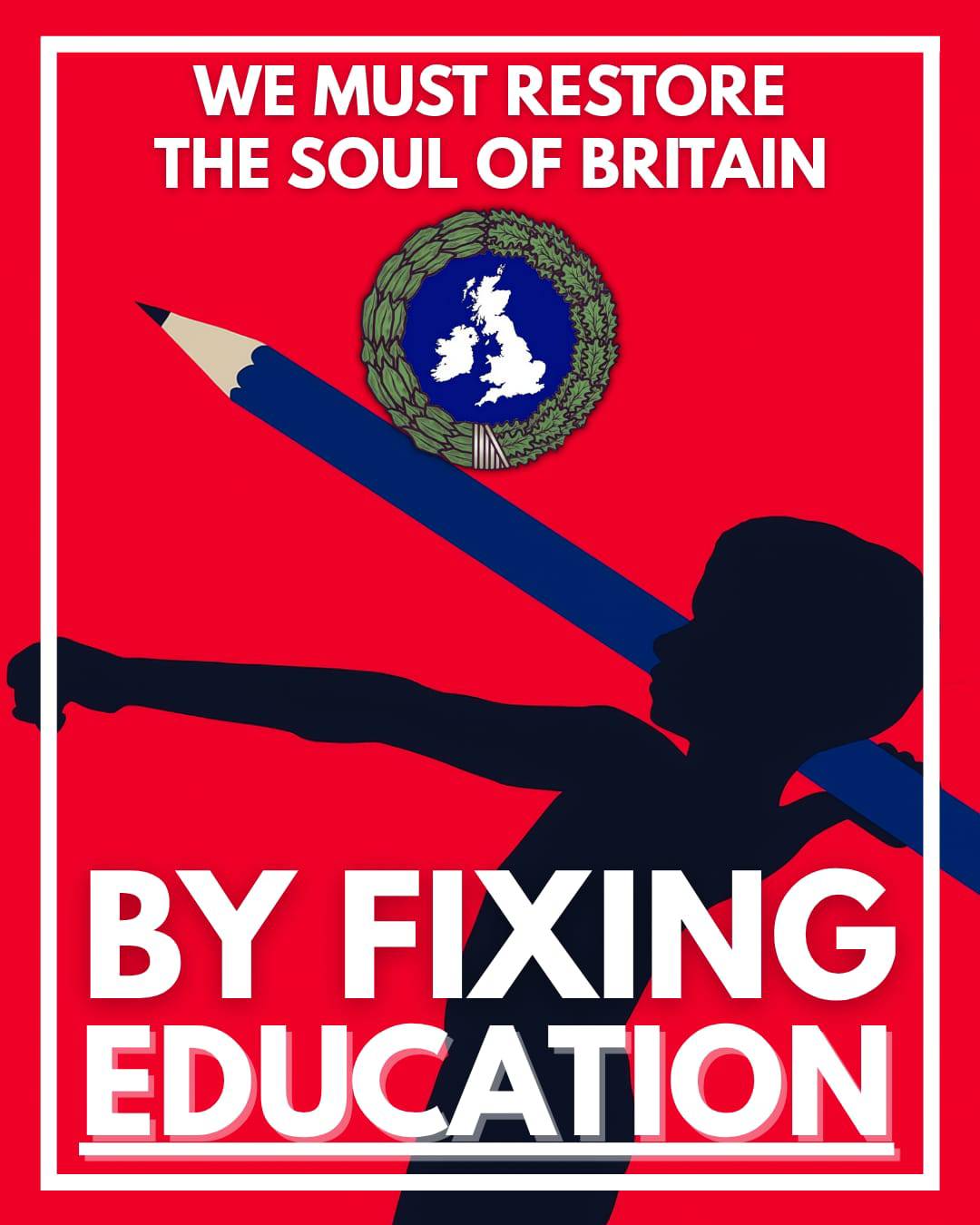
A patriotic government of the future must have the courage to undo the damage of the past sixty years. It must confront the sacred cow of comprehensive education and recognise that the system is beyond reform, it must be replaced.
First, Britain must reintroduce a modernised system, similar to the tripartite model in which academic ability, technical aptitude, and vocational potential are assessed through fair and rigorous testing, akin to the old 11-plus. Every child should have a place where their talents can flourish, whether in Grammar, Technical, or Vocational schools, each with equal dignity but distinct purpose. This is not elitism; it is justice.
Second, the separation of the sexes should be restored in secondary education. Boys and girls deserve to be taught in environments tailored to their natural differences. Boys need discipline, structure, and physical engagement; girls need encouragement, stability, and moral formation. Mixed classrooms confuse both. Sex education, if taught at all, should be modest, moral, and reserved for the later years, rooted in Christian principles of chastity, fidelity, and marriage, not in materialist notions of “safe experimentation.”
Third, the teaching profession must be reformed. Teachers should be called, not hired. It must once again be a vocation, not a bureaucratic career. Aspiring teachers should be judged not only on qualifications but on moral character, life experience, and where possible, parental understanding. Those who cannot instil discipline, reverence, and patriotism have no place shaping the young.
Fourth, school design and architecture must return to beauty and meaning. Classical forms, with columns, arches, and heritage symbols, should replace the brutalist and utilitarian designs of the present. A school should feel like a sanctuary of learning, not an office block. When a child walks through its gates, he or she should feel the weight and pride of belonging to something noble and enduring.
Fifth, and most importantly, schools must restore Christianity as their moral foundation. Morning prayer, hymns, Scripture readings, and the observance of Christian festivals must once again anchor the rhythm of school life. It is impossible to build moral character without a transcendent moral order. The values of discipline, charity, humility, and service, all essential to citizenship, derive from the Gospel, not from government guidelines.
All curricula, especially in history, English, art, and religious studies must be purged of Neo-Marxist and intersectional poison. British history must be taught in its fullness: the heroism of Trafalgar and Waterloo, the achievements of the Industrial Revolution, the compassion of our missionaries, the literary genius of Chaucer, Shakespeare and Chesterton, and the moral strength of our greatest leaders and common law. Children must once again be taught to love their country, not uncritically, but faithfully.
Lastly, a patriotic education should celebrate British festivals, traditions, and heroes. The days of our patron saints, Easter, May Day, Remembrance Day, Harvest Festival, All Saints Day, Guy Fawkes Night, Christmas etc. All must regain their rightful place in the school calendar. Children should sing the National Anthem with affection, fly the flag without fear, and see themselves as heirs to a living, sacred civilisation.
To complement this restoration, a patriotic government could also experiment with elements of Steiner/Waldorf methods of schooling, particularly with their emphasis on imagination, craft, and moral development. These philosophies, when rooted in Christian ethics and national identity, can enrich our education system, cultivating creativity without sacrificing discipline.
The battle for Britain’s future will not be won in Parliament or the media, it will be won in the classroom. Education is not merely a policy area; it is the forge of civilisation itself. As Plato wrote, “The direction in which education starts a man will determine his future life.” The direction of British education since the 1960s has led us to alienation, mediocrity, and despair.
It is time to turn back, to rediscover the eternal truths that built our schools, shaped our character, and made Britain great. We must once again see education as the formation of souls, not the training of workers; as the nurturing of citizens, not consumers. Our schools must be places where faith, patriotism, discipline, and beauty reign, where every child learns to love God, honour their country and serve their neighbour.
If we fail in this sacred duty, Britain will continue to fade into a rootless, forgetful nation, ashamed of its past and fearful of its future. But if we succeed, restoring our schools to their rightful purpose, we shall once again raise up a generation worthy of our forefathers: proud, free, faithful, and British.